
Pennsylvania State Prison Releases
Pennsylvania state prisons serve people sentenced to state confinement, including people committed from Philadelphia courts. Their release framework is statewide. PA DOC can house a Philadelphia-committing-county case at any institution in its system, and the location may change during the sentence. A state record is therefore not a Philadelphia Department of Prisons booking or a county-jail release record.
A person can leave an SCI on state parole, transfer to a community corrections center, move to another authority on a detainer, reach maximum sentence expiration, or complete another form of lawful separation. Parole means conditional release before the maximum term expires. It continues under PA DOC field supervision. A move into a community corrections center also reflects a change in custody level or location, not automatic full discharge.
When a current inmate-mode record becomes a supervised-person record with a Release Date, that supports release from state institutional custody into supervision. If another agency takes custody at the gate, the person has left the SCI but has not returned to the community. The record should state the receiving status instead of using “released” without qualification.
Find a Pennsylvania Prison Release
The PA DOC Inmate and Department Supervised Individual Locator provides two public modes. Inmate mode covers current state institutional jurisdiction. Department Supervised Individual mode is the release-first path for a person now on state parole. PA DOC says the service updates daily and excludes Philadelphia county-jail-only inmates and people held outside Pennsylvania.
Search methodically and preserve the status labels returned.
- Use inmate mode with at least a last name or inmate number. Add first name, date of birth, or other filters for a common name.
- Select Philadelphia as committing county only to narrow cases arising there. Do not treat that filter as proof the person is housed in Philadelphia.
- If parole is expected, search Department Supervised Individual mode by name or parole and inmate number.
- Match identifiers, read the Release Date and district, and note the record’s last update.
- If neither live mode resolves a former state inmate, review the UJS docket and seek a final Board Action or PA DOC separation record.
The state search supports a release conclusion only to the extent of its fields. A supervised-person match can show that state institutional release occurred and current supervision is reported. A missing live record does not prove that the person never served a state sentence. Fully discharged people may no longer appear.
The Philadelphia County released-inmate search covers the separate PDP, court, SAVIN, federal, and immigration paths when the responsible system is uncertain.
No Philadelphia State Prison Release
No active Pennsylvania SCI is located within Philadelphia County. SCI Chester lies in Delaware County, and SCI Phoenix lies in Montgomery County. Both may house people sentenced in Philadelphia, but neither should be labeled a Philadelphia County prison. Choosing one nearby institution as the default would omit people assigned elsewhere and create a false local roster.
Philadelphia’s four adult local jail facilities are CFCF, the Detention Center, PICC, and RCF. They cluster on State Road and belong to PDP. Historic Philadelphia prisons should not be presented as active. The official PDP facility list defines that local system, while PA DOC’s statewide locator defines the state route.
| Custody source | Correct public search | Release meaning |
|---|---|---|
| Philadelphia PDP jail | City PDP locator, PA SAVIN, UJS docket, PDP record | Local discharge or transfer |
| Pennsylvania SCI | PA DOC inmate and supervised-person locator | State institutional release, parole, or separation |
| PA DOC community corrections | Supervised-person locator and district office | Structured placement or supervision, not automatic discharge |
| Federal or immigration custody | BOP or ICE locator and federal records | Separate sovereign’s custody event |
A move from PDP to PA DOC is a transfer into state custody. It is not community release from the criminal justice system. The state record should be checked after the person leaves the county locator.
Note: Committing county identifies the case source; current location identifies the state placement. Those fields should never be treated as interchangeable.
Pennsylvania Prison Release Fields
Inmate mode can search first, middle, and last name, inmate or parole number, gender, committing county, current location, citizenship, date of birth, or approximate age. Details can include the state number, age or birth date, height, gender, citizenship, current and permanent location, committing county, aliases, photograph, and last-updated time. A current institutional result does not establish street release.
Department Supervised Individual mode can search name, parole or inmate number, gender, release date, date of birth or age, county of residence, and district office. Its details can include parole and inmate numbers, descriptors, state, Release Date, aliases, photograph, last update, and “Wanted: Parole Absconder.” That absconder label means the person is wanted for leaving supervision after release. It does not report a new release event.
| Public field | Supported conclusion | Unsupported conclusion |
|---|---|---|
| Current SCI location | PA DOC reports current institutional jurisdiction | The person has a set release day |
| Committing county: Philadelphia | The state case is tied to Philadelphia | The prison is in Philadelphia |
| Supervised Release Date | Institutional release occurred by the displayed historical date | Supervision ended that day |
| No result | No matching live record was resolved | No state-prison history exists |
Pennsylvania Prison Release Dates
The public PA DOC locator does not display a Projected Release Date, Tentative Release Date, minimum date, or maximum date. The supervised-person detail instead displays a historical Release Date for someone currently under state supervision. Pennsylvania’s sentence structure must be checked through the sentencing order, official computation, and parole record rather than an invented locator field.
Pennsylvania generally uses minimum and maximum terms. Under 42 Pa.C.S. § 9756(b)(1), the court-imposed minimum generally may not exceed one-half the maximum. The minimum is a parole eligibility threshold, not a promise of release. Under 61 Pa.C.S. § 6137(a)(3), the Parole Board cannot grant discretionary parole before minimum expiration. Even after a grant, an approved plan, conditions, processing, or detainer can delay or redirect physical release.
Pennsylvania also rejects the common 85-percent claim. The Parole Board’s official parole process says inmates are not required to serve 85 percent of the maximum to become eligible for parole. No general day-for-day good-time reduction applies to every state sentence in the reviewed official sources.
RRRI is a specific statutory route, not blanket good time. For an eligible person, 61 Pa.C.S. § 4505(c) calculates the RRRI minimum at three-fourths of a regular minimum of three years or less, or five-sixths when the minimum exceeds three years. Eligibility, court imposition, DOC programming, conduct, reentry planning, certification, and public-safety findings matter. Arrival at an RRRI minimum creates no automatic right to parole.
Note: Label each date as minimum, maximum, RRRI minimum, Board action, supervised-person Release Date, or actual separation to avoid a false promise.
Pennsylvania Prison Release Records
When the public locator is incomplete, gather the records in sequence. Retrieve the UJS criminal docket and sentencing order to identify the imposed term, credit entries, and later court action. Ask PA DOC Sentence Computation or records personnel for the current official calculation when it is not public. Check whether the sentencing court imposed RRRI and whether DOC certification occurred. Then review the final Board Action to determine whether parole was granted to the street or to a detainer.
Actual release can be confirmed through the supervised-person Release Date, PA SAVIN notification, or an agency separation record. PA SAVIN covers state prisons and state parole, but its event notice is not a certified discharge record. It should be matched to the right person and cross-checked when the precise legal status matters.
PA DOC locator assistance
ra-contactdoc@pa.gov
Pennsylvania Parole Board Open Records
Janaki Theivakumaran, Agency Open Records Officer
1101 South Front Street, Suite 5100
Harrisburg, PA 17104-2521
RA-pbpprighttoknow@pa.gov
Posted hours: Monday-Friday, 9 a.m.-5 p.m.
A focused PA DOC request identifies the DOC number, institution, release or separation date, and exact existing record. A final Board Action request should be separate. The Board policy treats final decisions as public after the person receives a copy, while permitting redaction of protected matter.
Pennsylvania Release Search Screen
The PA DOC locator screenshot below is the relevant search image for Philadelphia state sentences. It is statewide and should not be captioned as a county jail roster.
Visit the official Pennsylvania locator to check the current inmate and supervised-person modes.
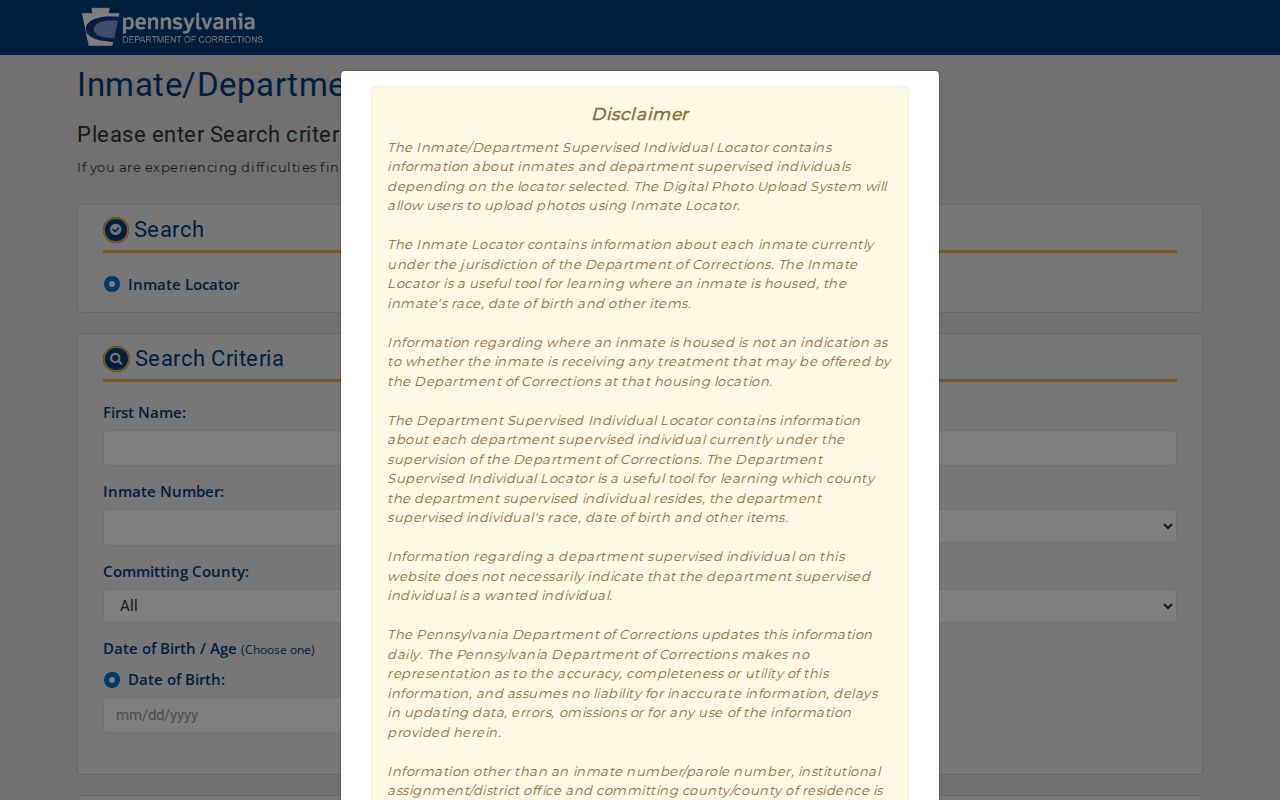
The displayed mode, date labels, location, and last-update time control what can be said about a specific release.
PA DOC warns that some biographical data may be self-reported and not independently verified. Match the state number and other identifiers instead of relying on name alone. If display features fail, the service suggests disabling pop-up blocking and contacting the department. A careful search records the mode used, filters entered, and time checked.
After Pennsylvania Prison Release
A person released on state parole receives reporting instructions before departure. The supervised-person locator may show the assigned district office. In Philadelphia, state field supervision is handled through PA DOC district and suboffice staff. A community corrections placement such as Philadelphia CCC No. 2 may also be part of the release plan. Neither status equals complete discharge.
- Institutional release
- Departure from an SCI, possibly into parole, a center, or another authority.
- Parole
- Conditional community release while the state sentence and supervision continue.
- Grant to detainer
- Parole action that sends the person to another custody basis instead of the street.
- Final discharge
- Lawful completion of the applicable state custody and supervision, best shown by agency records.
County probation must remain separate. A person sentenced to Philadelphia county supervision may not appear in the state locator at all. Conversely, a state supervised-person result is not a PDP release record. State and local sources can concern the same person while documenting different cases and different legal authority.
When no single source answers the question, state exactly what each does show. That approach is more accurate than turning a roster disappearance, parole grant, minimum date, or CCC placement into an unsupported claim of full release.